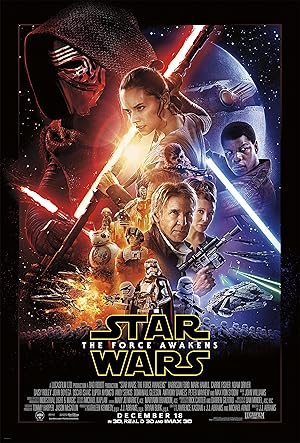
Star Wars: Episode VII - The Force Awakens
Directed by J.J. Abrams
TheoScope Rating
Worldview · content · moral framework
Plot
30 years after the defeat of Darth Vader and the Empire, Rey, a scavenger from the planet Jakku, finds a BB-8 droid that knows the whereabouts of the long lost Luke Skywalker. Rey, as well as a rogue stormtrooper and two smugglers, are thrown into the middle of a battle between the Resistance and the daunting legions of the First Order.
Discern Score Breakdown
30%
30%
25%
15%
Audience Suitability
Kids
Under 10
Teens
10–17
Adults
18+
Family
Mixed ages
Content Flags
The Force Awakens is a well-crafted, emotionally grounded blockbuster that revives classic Star Wars themes of good versus evil, courage, and chosen family. Theologically it operates in a secular-spiritual register — the Force is a persistent philosophical alternative to Christian theism that serious families should be prepared to discuss. Its strongest Christian-adjacent themes are found in Finn's conscience-driven defection and the film's insistence that individual moral choices matter.
Pastoral Take
The Force Awakens is a safe and enjoyable watch for most teenagers and adults, and many families with children 10 and older will find it manageable — but parents should be ready for the emotional punch of Han Solo's death, which is the film's most disturbing moment and may hit harder than expected for younger kids or those who grew up with the character. The Force as a spiritual concept is the most theologically significant thing to address: it's not hostile to faith, but it quietly teaches a pantheistic alternative to a personal God, and children who are curious and spiritually-minded will benefit from a brief, calm conversation about the difference. There's genuine redemptive value in Finn's moral courage and the film's clear insistence that evil is real and worth opposing — this is a film where good and evil mean something, which is worth affirming.
Discussion Points
- 1When Finn refuses to fire on the villagers at the beginning of the film, he risks everything to do what he knows is right — even though everyone around him does it without hesitation. Have you ever been in a situation where the people around you were doing something wrong and you had to decide whether to go along or stand apart? What does the Bible say about following the crowd versus following your conscience?
- 2Han Solo is clearly trying to reconnect with his son Ben, and even at the moment Kylo Ren kills him, Han reaches up to touch his face rather than fight back. What do you think Han was hoping for in that moment? How does that compare to the story of the prodigal son in Luke 15 — and what does it tell us about how love responds even to betrayal?
- 3Rey spends the whole movie insisting she has to go back to Jakku and wait — even though everyone can see she's meant for something bigger. Why do you think it's so hard to let go of where we came from, even when God might be calling us somewhere new? Are there any places in the Bible where someone had to leave behind what felt safe in order to follow a bigger purpose?
- 4Kylo Ren tells Rey he can show her the ways of the Force, but what he's really offering is power on his terms. How can you tell the difference between someone who wants to guide you toward what's good and someone who just wants to use your gifts for their own purposes? What does the Bible say about testing the intentions of people who offer to lead or teach you?
Want to check another movie?
Unlock every movie in our database — free for 7 days. No credit card required.
Cast
Daisy Ridley, John Boyega, Oscar Isaac
Community Reviews
to leave a review