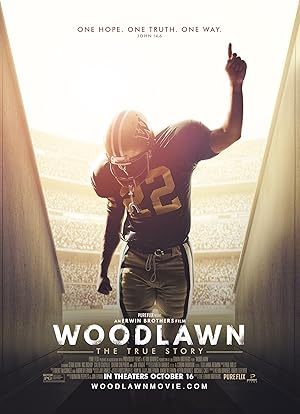
Woodlawn
Directed by Andrew Erwin, Jon Erwin
TheoScope Rating
Worldview · content · moral framework
Plot
When Woodlawn High School in Birmingham, Alabama is controversially desegregated in 1973, Tony Nathan, a gifted black high school football player, joins the school's predominantly white football team along with several other black players. The coach, Tandy Gerelds, tells the team to use their shared anger to unite them, but black and white players clash on and off the field. After a riot at the school, Gerelds consents to allowing traveling sports chaplain Hank Erwin to speak to the team as a "motivational speaker". Hank's speech moves nearly the entire team to accept Hank's invitation to commit their lives to Jesus Christ, and join together in prayer. Gerelds does not accept the invitation, and is unsure what to make of the event..
Discern Score Breakdown
30%
30%
25%
15%
Audience Suitability
Kids
Under 10
Teens
10–17
Adults
18+
Family
Mixed ages
Content Flags
Woodlawn is a rare faith-based film that earns its theological weight through honest storytelling rather than sentimentality. Set against the turbulent backdrop of forced desegregation in early-1970s Birmingham, it presents the gospel of Jesus Christ as both personally transformative and socially revolutionary, and does so with sincerity and craft. It lands as one of the stronger entries in Christian cinema, though the racial violence and intensity of the historical setting make it better suited to older children and adults than to young kids.
Pastoral Take
Woodlawn is genuinely one of the best faith-based films your family can watch together, and it deserves a place in your home. The content is appropriate for teenagers and adults without reservation, though the intensity of the racial violence and the historical ugliness of desegregation-era Alabama may be disturbing for children under 10 — watch it with them and be ready to explain what they're seeing. The film's honest treatment of racism as sin and the gospel as the only sufficient remedy makes it an exceptional springboard for real conversation, and parents of teenagers especially will find it rewarding to watch together.
Discussion Points
- 1When nearly the whole football team responded to Hank's invitation and committed their lives to Christ, the racial divisions in the locker room began to break down. Why do you think faith was able to do something that Coach Gerelds' motivational speeches and team rules couldn't? What does the Bible say about where real change in the human heart comes from?
- 2Tony Nathan faced hatred and unfair treatment from players, coaches, and fans who saw him as a threat just because of his race. He responded with perseverance and dignity instead of bitterness. Can you think of a biblical figure who was treated unjustly but chose a similar path — and what did that cost them and what did it produce?
- 3Coach Gerelds was skeptical and even resistant when Hank first spoke to the team — he allowed it, but he held back from the invitation himself. Why do you think it was harder for him to step forward than it was for the players? Have you ever seen someone close to you take longer to respond to faith, and what finally moved them?
- 4The film shows that the gospel brought black and white players together in ways that laws and authority figures couldn't force. Do you think Christian unity across racial lines looks different from just being polite or tolerant of each other — and what does it actually require of us, practically speaking?
- 5At the end of the film, Tony's story isn't wrapped up in a perfect bow — there's still hardship ahead in real life. Why do you think the filmmakers chose to be honest about that instead of giving everyone a completely happy ending, and what does that say about what the Christian life actually promises us?
Want to check another movie?
Unlock every movie in our database — free for 7 days. No credit card required.
Cast
Caleb Castille, Sean Astin, Jon Voight
Community Reviews
to leave a review