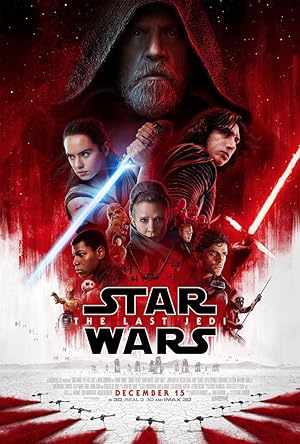
Star Wars: Episode VIII - The Last Jedi
Directed by Rian Johnson
TheoScope Rating
Worldview · content · moral framework
Plot
Jedi Master-in-hiding Luke Skywalker unwillingly attempts to guide young hopeful Rey in the ways of the force, while Leia, former princess turned general, attempts to lead what is left of the Resistance away from the ruthless tyrannical grip of the First Order.
Discern Score Breakdown
30%
30%
25%
15%
Audience Suitability
Kids
Under 10
Teens
10–17
Adults
18+
Family
Mixed ages
Content Flags
The Last Jedi is a visually ambitious, thematically ambitious blockbuster that wrestles with the nature of heroism, failure, legacy, and hope within a secular-pantheistic mythology. It is not hostile to Christian values but operates entirely outside a Christian framework, and its spiritual content — while fictional — is coherent enough to shape how younger viewers think about the transcendent. The film is best suited for families with teenagers who can process its thematic complexity and intensity.
Pastoral Take
The Last Jedi is appropriate for older children and teens — roughly 11 and up — though parents of sensitive or younger kids should be cautious given the intensity and length of the battle sequences and some emotionally heavy character moments. The film has genuine moral and even quasi-spiritual substance worth discussing: sacrifice, hope, and the weight of failure are real themes handled with some seriousness. However, parents should be ready to gently name that the film's spiritual framework — the Force as a universal, impersonal energy available to anyone — is a coherent but non-Christian spirituality that is worth distinguishing from a biblical understanding of God as personal, relational, and sovereign.
Discussion Points
- 1Luke spent years hiding on an island because he felt his greatest failure — nearly killing his nephew — disqualified him from doing any more good. Have you ever felt like a mistake you made meant God couldn't use you anymore? What does the Bible say about whether our failures get the final word? (Think about Peter after he denied Jesus three times.)
- 2Kylo Ren tells Rey that the past should be 'killed' — that holding onto it only holds you back. Do you think that's true? What's the difference between being weighed down by the past and honoring the things that came before us? What does it mean in the Bible to remember and pass on what God has done?
- 3At the end of the film, a young slave boy who no one has ever heard of reaches toward the stars with hope. The film seems to be saying that heroism isn't about special bloodlines or chosen ones — it can come from anyone. Do you agree? How does that compare to what the Bible says about who God chooses to use, and why?
- 4Vice Admiral Holdo kept her plan secret and was nearly mutinied against, but she turned out to be right — and she gave her life for the Resistance. Poe had to learn to trust leadership even when he didn't understand it. Can you think of a time when trusting someone else's plan — or trusting God — felt impossible? What made it hard, and what made it worth it?
- 5Luke tells Rey that the Jedi have failed before and that holding onto them as a symbol of perfect heroism is dangerous. He says failure is the greatest teacher. Do you think that's a biblical idea? What's the difference between learning from failure in a healthy way and using the idea of failure to give up on something good?
Want to check another movie?
Unlock every movie in our database — free for 7 days. No credit card required.
Cast
Daisy Ridley, John Boyega, Mark Hamill
Community Reviews
to leave a review